
What is an Ischial Bursitis?
Ischial bursitis is bursitis affecting the buttock region. The bursitis is mainly due to chronic and continuous irritation of the bursa and occurs most often in individuals with a sedentary lifestyle. A bursa is a small sac filled with fluid that acts as a cushion and allows smooth motion by reducing the friction between muscles and bone. The irritation commonly results from prolonged pressure on the ischium.
Ischial bursitis commonly occurs from direct trauma to the area, sitting for long periods on a hard surface, or from injury to the hamstring muscle or tendon through activities such as bicycling or running.
What is an Ischial Bursectomy?
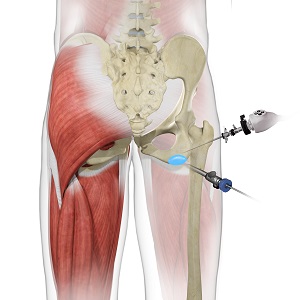
Bursectomy is the surgical removal of the bursa, a small fluid-filled sac around the muscles, tendons, and bones of the joints in order to minimize friction and irritation. An ischial bursectomy is a surgical procedure whereby the bursa that lies between your buttock muscle and your sitting bone is removed. Ischial bursectomy is usually performed arthroscopically as a minimally invasive procedure. An arthroscope is a small, fiber-optic instrument consisting of a lens, light source, and tiny camera. The camera projects images onto a monitor, allowing your surgeon to assess any damage and perform a repair.
What is the Procedure for Ischial Bursectomy?
The surgery is performed under general or regional anesthesia and involves the following steps:
- Arthroscopic portals are inserted through a small incision at the joint.
- Your surgeon performs diagnostic arthroscopy to view the inflamed bursa or bursae.
- Special surgical instruments are inserted through another small incision.
- Your surgeon carefully removes the inflamed bursae and any surrounding scar tissue.
- The incisions are closed, and a bandage is applied.
What are the Risks and Complications of Ischial Bursectomy?
Complications are few but can include:
- Pain
- Swelling
- Bruising
